
Monitoramento do mercado de ônibus elétricos na América Latina (2024)
Market Spotlight
Latin America e-bus market monitor (2024)
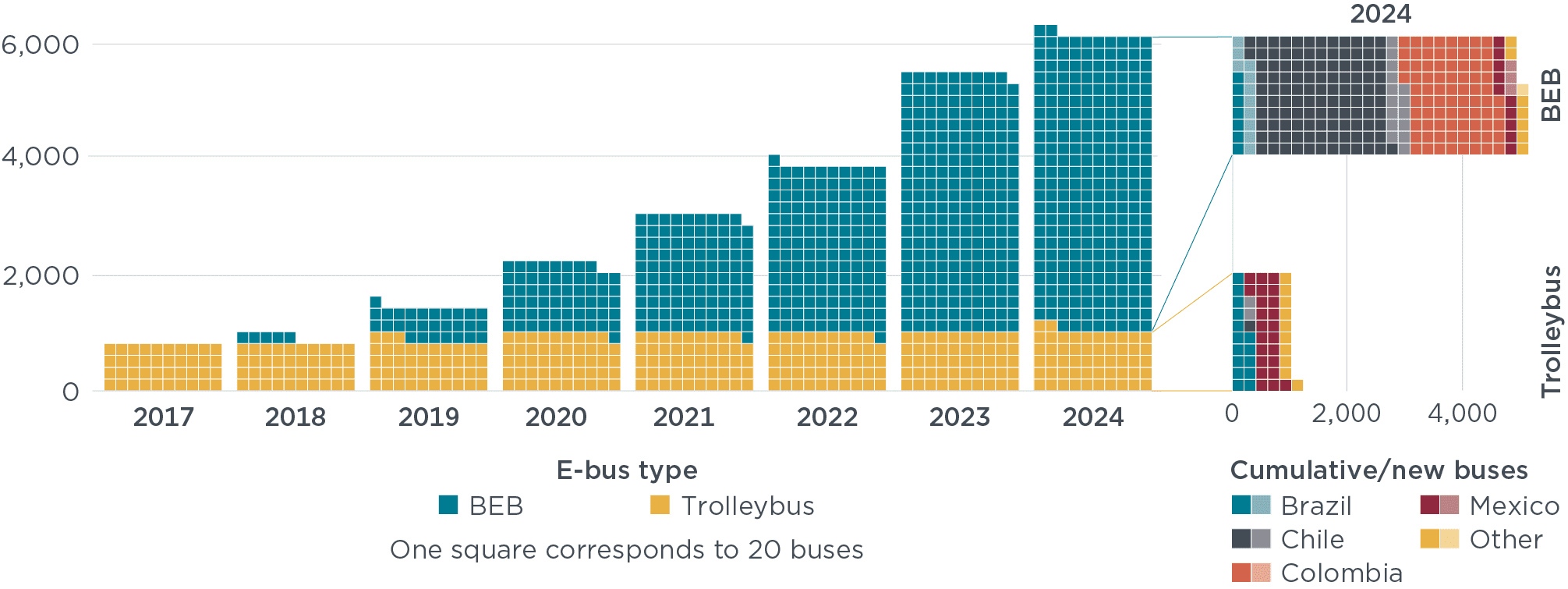
Latin America’s electric bus (e-bus) fleet reached 6,055 vehicles at the end of 2024, an increase of 13% from the year prior. The fleet has grown substantially since 2017—when it comprised just 801 vehicles, nearly all trolleybuses—and the average growth rate has been 33.5% per year. This growth was initially boosted by the introduction of battery electric buses (BEBs) in Chile and Colombia, followed by Brazil and Mexico. The trolleybus fleet, concentrated in Brazil and Mexico, has had a more limited expansion, but still was 17% of all e-buses in Latin America in 2024.
Figure 1. Evolution of Latin America’s e-bus fleet by year and country, 2017–2024
Major E-bus cities
E-buses in Latin America are concentrated in a few cities. Santiago and Bogotá account for over 65% of the region’s e-bus fleet. Approximately 72% of new BEBs added in 2024 were deployed in Santiago (34%), São Paulo (30%), and Mexico City (8%). Trolleybuses represent 100% of the e-bus fleet in Quito, 73% in Mexico City, and 44% in São Paulo. Santiago and Bogotá have only BEBs in operation.
Figure 2. E-bus fleet by city, 2024

Life-cycle emissions
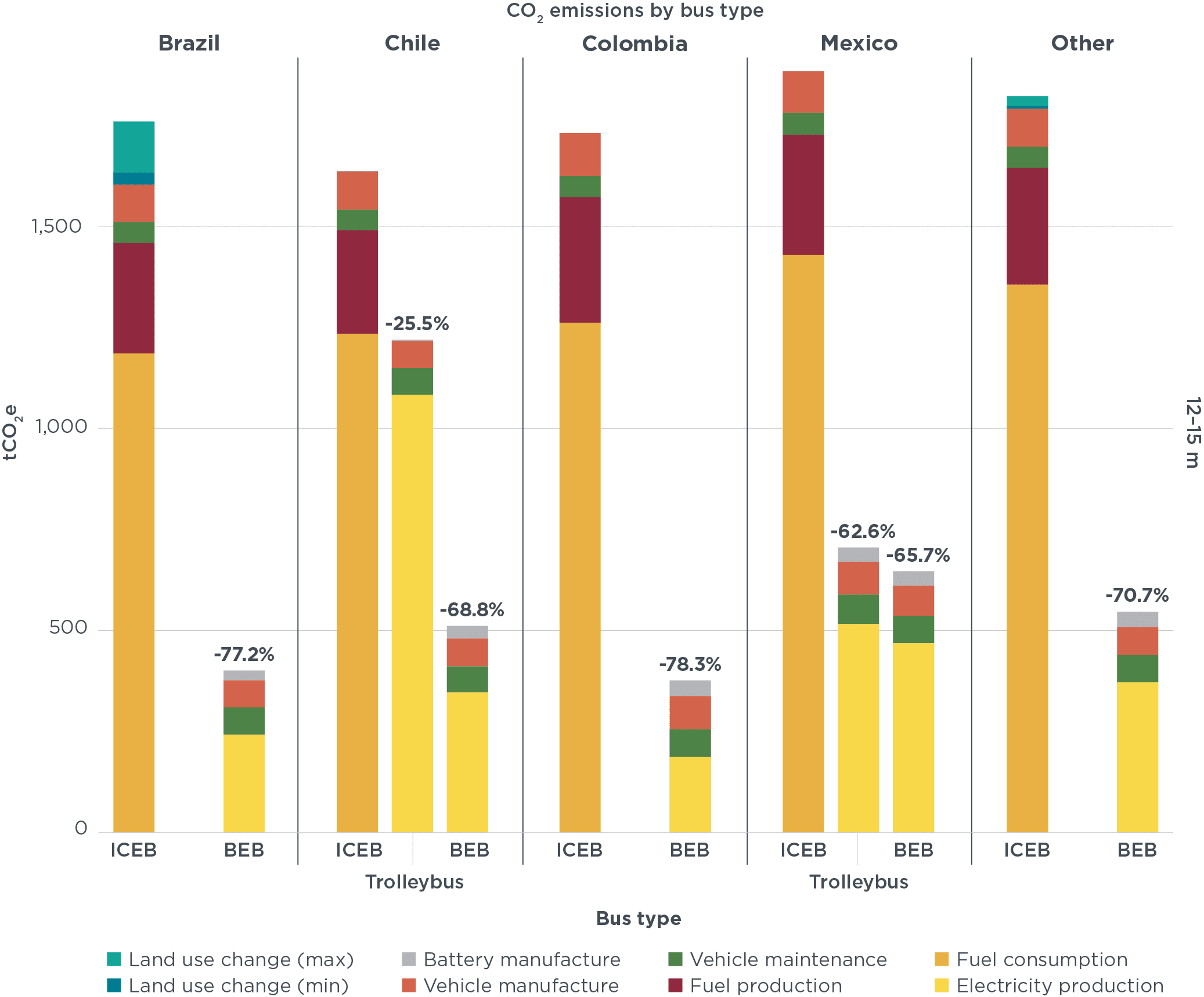
Internal combustion engine buses (ICEBs) produce, on average, 2 times more greenhouse gas (GHG) emissions than trolleybuses and 3–4 times more than BEBs.
Country characteristics influence emissions per vehicle, especially for electric buses: BEBs operating in Mexico and Chile emit 1.2–2 times more than equivalent vehicles in Colombia or Brazil due to different carbon intensities of the electric grids in these countries.
Considering the most common bus size in Latin America (12–15 m), BEBs in Colombia and Brazil emit 78.3% and 77.2% less GHG than ICEBs, respectively. In Mexico, emission reductions relative to ICEBs are comparable for BEBs (65.7%) and trolleybuses (62.6%); in Chile, by contrast, BEBs emit 68.8% less than ICEBs while trolleybuses achieve a more modest reduction of 25.5%. On average, in all other countries, BEBs emit 70.7% less than ICEBs.
Figure 3. Comparison of life-cycle emissions of 12–15m buses, by country
E-bus manufacturers by country
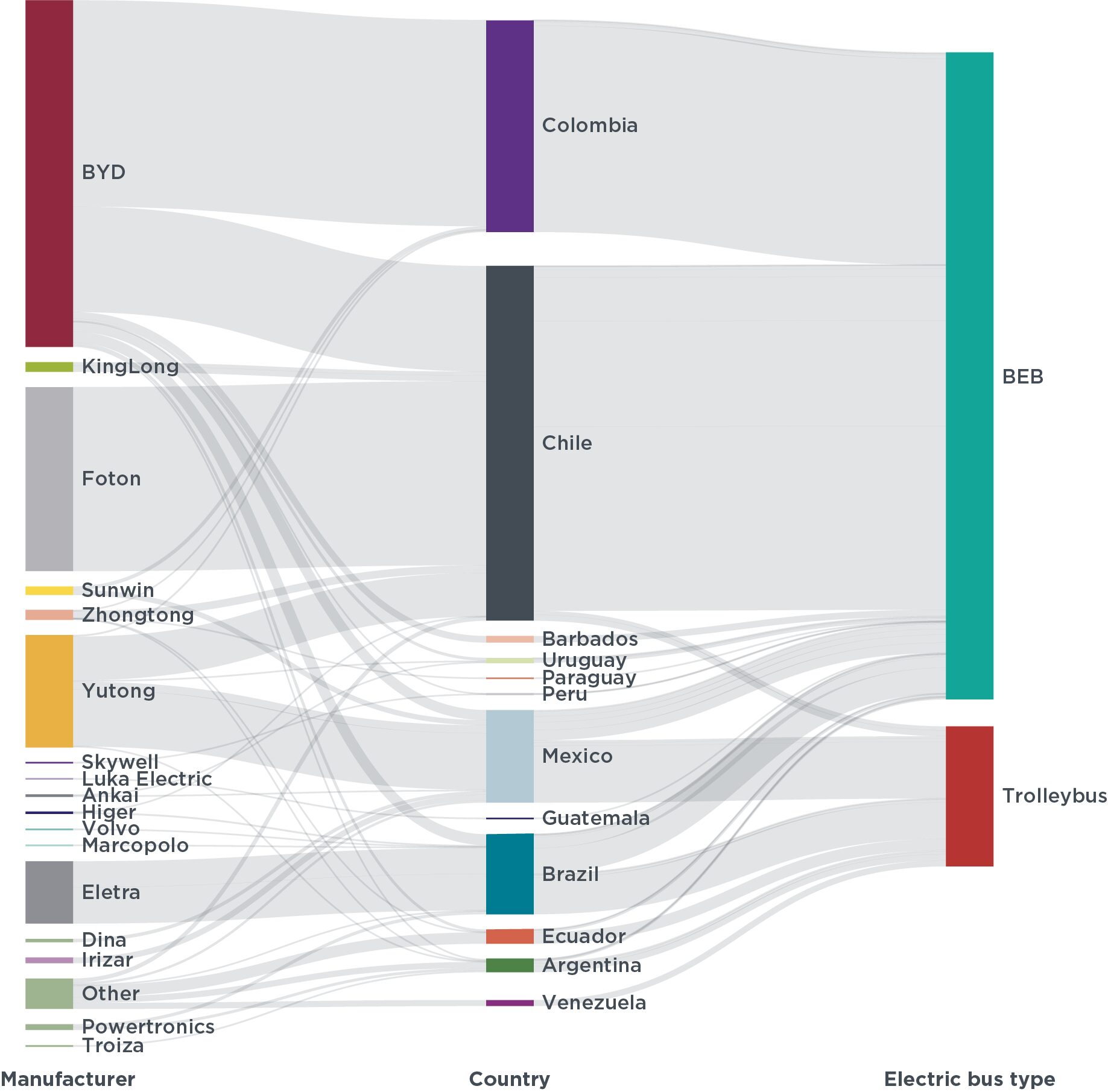
From 2018 through 2024, BYD was the largest supplier of e-buses to Latin America, with 2,606 buses—43.7% of the regional fleet—sold mostly in Colombia and Chile. This was followed by Foton, with 1,404 buses sold almost exclusively in Chile, and Yutong, whose 890 buses were concentrated mainly in Mexico and Chile. Brazilian company Eletra sold 477 BEBs and trolleybuses over the period, all in Brazil.
KingLong (72 e-buses), Zhongtong (70), Sunwin (64), and Mercedes-Benz (62) rounded out the top eight suppliers to the region between 2018 and 2024. Other manufacturers were responsible for 472 e-buses, or 7.8% of the fleet.
Of the 6,055 e-buses deployed in the region since 2018, 5,147 vehicles—85% of the fleet—were supplied by Chinese manufacturers. Latin American manufacturers Eletra, Marcopolo (Brazil), and DINA (Mexico) were responsible for 545 vehicles, or 9% of the fleet. European manufacturers combined supplied 114 buses, or 1.9% of the fleet.
Figure 4. Distribution of Latin America’s e-buses acquired since 2018 by manufacturer (left), country (center), and bus type (right)
Definitions and data sources
Data were retrieved from E-BUS RADAR (ebusradar.org), which is maintained by the Zero Emission Bus Rapid-deployment Accelerator (ZEBRA) partnership with support from Instituto Clima e Sociedade. As of December 2024, E-BUS RADAR had mapped over 6,000 e-buses in Latin America, covering 12 countries and 55 cities.
The methods to calculate life-cycle emissions are presented in Ana Beatriz Rebouças and André Cieplinski, Quantifying avoided greenhouse gas emissions by e-buses in Latin America: A simplified life-cycle assessment methodology (International Council on Clean Transportation, 2024), https://theicct.org/ publication/quantifying-avoided-ghg-emissions-by-e-buses-in-latin-america-a-simplified-life-cycle-assessment-methodology-aug24/.
Electric buses include both battery electric buses and trolleybuses.
Battery electric buses are electric buses propelled by electric motor(s) with on-board battery packs.
Trolleybuses are electric buses propelled by electric motor(s) with energy obtained from an overhead cable; they may or may not have on-board battery packs.
Internal combustion engine buses are propelled by a combustion engine fueled by diesel or compressed natural gas.