
Estimating sustainable aviation fuel feedstock availability to meet growing European Union demand
Working Paper
An estimate of current collection and potential collection of used cooking oil from major Asian exporting countries
As a low-carbon feedstock for biofuel that is both technologically mature and commercially available, used cooking oil (UCO) is ideal for meeting existing biofuel mandates in Europe and the United States. Proposed revisions to the European Union’s the Renewable Energy Directive (RED II) and new proposals that incentivize the use of renewable fuels in the aviation and marine sectors are likely to stimulate even more demand for UCO imports in Europe. At the same time, the demand for UCO for biofuel within Asia is increasing, as well. This study explores literature to assess how much UCO is likely to be available from six major UCO-exporting Asian countries—China, India, Indonesia, Japan, Malaysia, and the Republic of Korea—to consider the potential availability of what is inherently a limited resource.
The table below is a summary of our estimates, and the estimates of collection potential assume 100% collection from urban restaurants, 50% from urban households, and 100% from food processing nationwide. UCO in the illicit gutter oil market is not considered, due to lack of data. However, any UCO surpluses in the final column, particularly in China, India, and Indonesia, might not exist because the UCO could be used in the gutter oil market. Studies suggest that gutter oil is a problem in these three countries, even as their governments try to address it through things like a biofuel program or adjusting the market price of cooking oil to increase legal UCO collection. Note, too, that due the assumptions made about current collection, uses, trade, and lack of data on gutter oil, this work may underestimate or overestimate any surplus or deficit identified in the final column of the table.
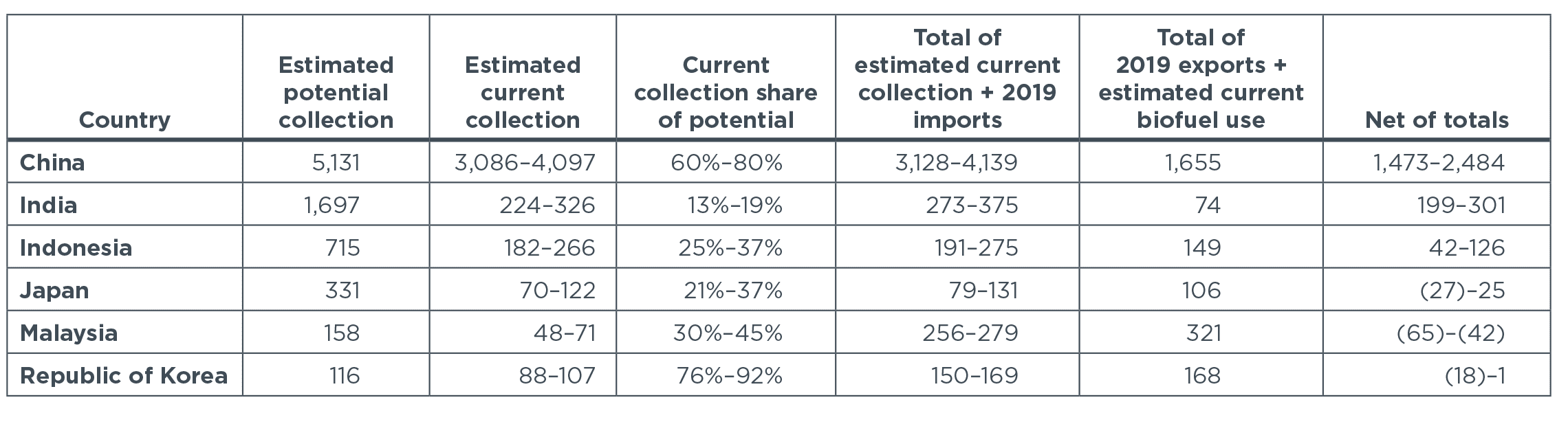
Table 1. Summary of estimates of UCO potential, UCO collection, import-export, and biofuel use, in kilotonnes per year.
We further estimate that the European Union could demand around 3,500 kilotonnes of UCO imports in 2030 if a proposed revision to RED II goes into effect. The two new proposals, FuelEU Maritime and ReFuelEU Aviation, would further incentivize additional UCO-based fuels beyond the incentives in RED II. In 2035, for example, the ReFuelEU Aviation 15% SAF mandate (outside the 5% submandate) could incentivize demand for 5,600 kilotonnes of UCO imports. These are a sizeable amount when compared to our total estimate for current collection in these six countries, which is between 3,700 and 5,000 kilotonnes. We therefore suggest the European Union include 1.7% caps on waste oils in amendments to both ReFuelEU Aviation and FuelEU Maritime, to align with the 1.7% cap on waste oils in RED II. Such caps are reflective of a desire to stimulate other kinds of renewable fuels in addition to those derived from waste oils like UCO.
Attachments
Europe Fact Sheet – UCO potential
Europa–Faktenblatt zum Potenzial von Altspeiseöl
Indonesia Fact Sheet – UCO potential
Fact Sheet Indonesia – Potensi UCO