Blog
Revisions to the EU ETS set a global model for sustainable aviation fuel investment
The EU Emissions Trading System (EU ETS), established by the European Commission, guides economy-wide emission reductions by setting a limit on the quantity of greenhouse gas (GHG) emissions that can be produced by the industries it covers each year. Amendments that took effect early this year are designed to better align the program with the European Union’s net-zero emission target for 2050. Regarding aviation, these changes set a useful example for other regions looking to deploy sustainable aviation fuels (SAFs).
Utilities and heavy industry (“stationary installations”) were the first sectors regulated under the EU ETS, and aircraft operators were added in 2012. Aircraft operators were granted additional flexibilities in complying with the annual targets that weren’t available to others. For example, between 2013 and 2020, allowances covering 82% of aviation emissions were allocated for free. Aviation allowances are also tracked and auctioned separately because of overlapping regulations that govern aircraft emissions; they are known as European Aviation Allowances, and they’re kept in a separate pool.
The recent revisions expand EU ETS emissions coverage to the maritime sector and establish a new system known as the ETS2 to cover the building sector, the road sector, and small industries not regulated under the original EU ETS. Revisions also accelerate the annual rate—known as the linear reduction factor (LRF)—at which both the stationary installation and aviation GHG emission limits shrink. The treatment of allowances for aviation emissions was also changed: The free allowances will be fully phased out by 2026, after declining to 64% and 43% of sectoral emissions in 2024 and 2025, respectively. This means that by 2026, aircraft operators will need to purchase all their allowances at auction like those in other sectors. It’s also possible that the scope of aviation emissions covered may be broadened beyond intra-European Economic Area (EEA) flights; that will be determined following an evaluation of the program in 2026. The measures adopted early this year are more ambitious than a previous EU ETS proposal, which we analyzed in this paper.
Critically, the EU ETS revisions create a re-investment mechanism that sets aside 20 million allowances for aircraft operators to offset the higher cost of SAF production; these are available from 2024 to 2030 and must be drawn from the aforementioned pool of European Aviation Allowances. Aircraft operators can use the allowances to cover between 50% and 100% of the cost difference between fossil kerosene (colloquially referred to as “fossil jet”) and SAF, depending upon the fuel pathway used. Additionally, the Commission can later choose to extend this funding mechanism by a set amount through 2034.
The SAF re-investment mechanism will help to narrow the cost gap between second-generation advanced fuel pathways that provide some of the largest climate benefits and fossil fuels. The mechanism rewards fuels in tiers, and the lowest-GHG aviation fuels receive the most funding. Aircraft operators will receive 95% of the cost differential between renewable fuels of non-biological origin (including liquid e-fuels and hydrogen derived from renewable electricity) and fossil jet, after adding on taxes on fossil fuel. Advanced biofuels as defined in the Renewable Energy Directive will receive 70% of the cost differential, and all other SAF covered under the ReFuelEU mandate qualifies for 50% of the cost differential. With this, the European Union is prioritizing support for fuels made using nascent technologies over ones made via mature technologies that are already widely commercialized.
Let’s explore how much this support could narrow the cost gap between fossil jet and synthetic kerosene between now and 2030. First, we assume the cost of fossil jet will remain around €0.75/liter, based on Energy Information Administration petroleum price data. Fossil jet has an implicit carbon price of €0.25/liter, assuming an emissions trading price of €100/tonne of carbon dioxide equivalent. We expect that synthetic kerosene, or “e-fuels,” will cost approximately €2.30/liter, based on the average cost of producing e-kerosene in the European Union between 2025 and 2030, and that’s an approximately €1.25/liter cost premium.
To convert this cost premium into a total cost gap, we consider the cumulative volume of e-fuel that aircraft operators must purchase under the ReFuelEU aviation sub-mandate for synthetic fuel. We assume that e-fuel production scales up exponentially from zero to meet interim ReFuelEU blending targets and that by 2030, aircraft operators are required to blend e-fuels into their fuel mix at an average of 1.2% by volume. As a result, aircraft operators would have to blend approximately 3.2 billion liters of e-fuels into their fuel mix between now and 2030, and that comes out to a cumulative cost gap of approximately €3.6 billion.
Figure 1 illustrates how the annual cost gap between fossil jet and e-kerosene could play out. In the hatched bars, we see the annual cost gap grows from nearly €400 million in 2025 to €830 million in 2030; this is due to the increasing entry of e-fuels under the ReFuelEU synthetic fuel sub-mandate. However, the blue portion of the hatched bars represents proposed revisions to the Energy Taxation Directive (ETD) that would tax fossil jet at a rate of €0.369/liter, and this would close this gap by the amount shown if adopted. Under the proposed EU ETD, e-kerosene would also be taxed at a nominal rate of €0.005 per liter, but it’s unclear when or if either of these tax revisions will take effect.
Figure 1. Annual cost gap between fossil jet and e-kerosene under the revised EU ETS and the impact of the proposed ETD tax
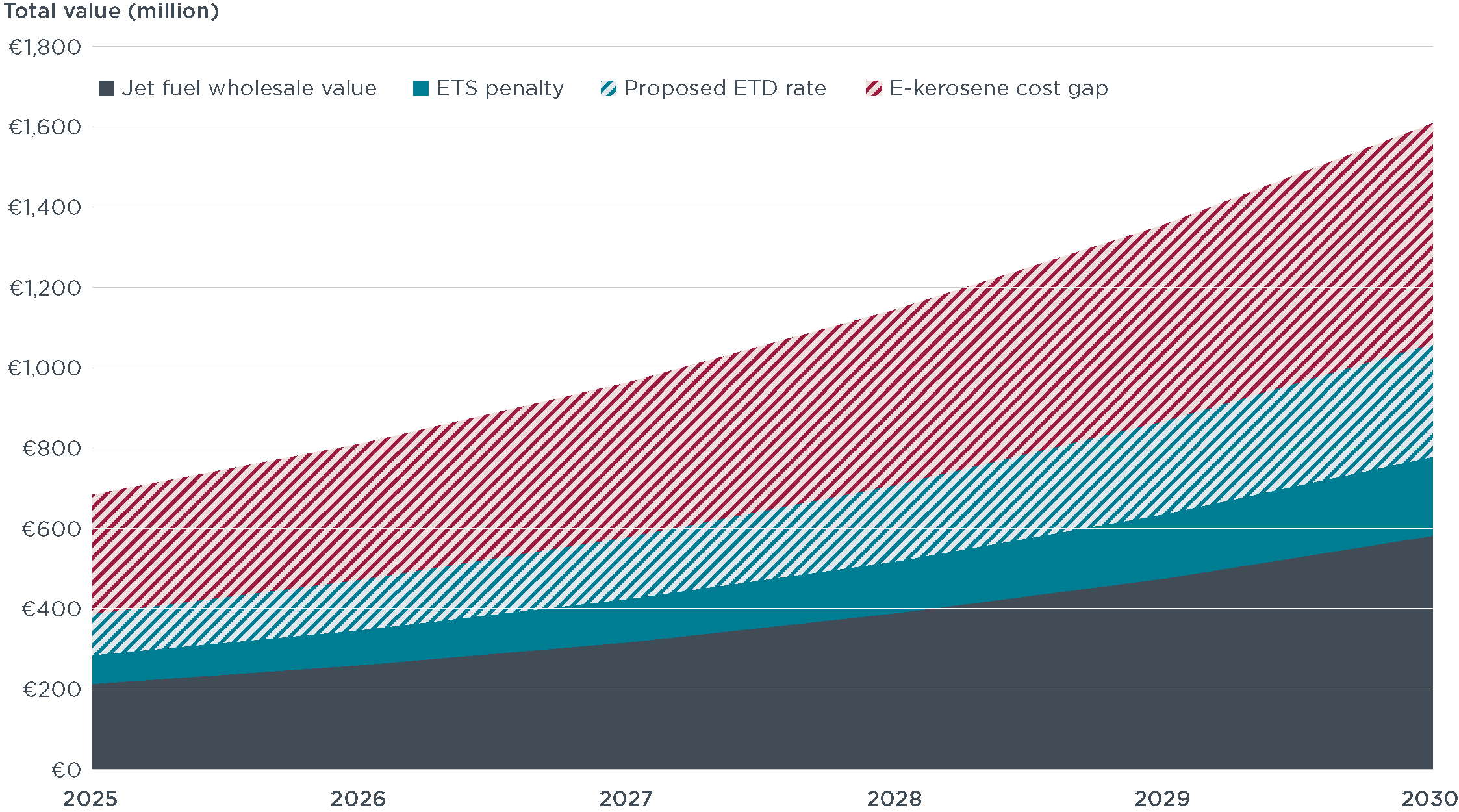
We estimate that the cumulative cost gap between fossil jet and e-kerosene in the European Union through 2030 is €3.6 billion without the ETD and €2.5 billion if the proposed ETD comes into force. The funding allocated under the EU ETS allowance reserve is about €2.0 billion, which is theoretically enough to cover up to 80% of the cumulative cost gap between fossil jet and e-kerosene, assuming the ETD is implemented. It’s unlikely that it’ll cover that much, though, because we expect that a considerable portion—potentially well more than half—of this funding could be directed toward offsetting the costs of other fuel pathways such as advanced biofuels.
Nonetheless, in combination with the volume mandate from ReFuelEU, the EU ETS revisions create a durable mechanism to reinvest some funding into the lowest-GHG SAF pathways such as e-fuels while also effectively raising the cost of GHGs from fossil jet fuel. This mechanism offers insights for others that seek to use such levers to reduce the cost gaps in their own regions.
Author

Jane O’Malley
Researcher
Related Publications
Argues that the EU’s new “Fit for 55” proposals could be leveraged to steer more revenue toward development of sustainable aviation fuels, and to discourage use of fossil jet fuel.