
How has the Renewable Fuel Standard impacted food and feed prices?
Blog
U.S. Renewable Fuel Standard proposal would mean more vegetable oil imports, high costs, and minimal greenhouse gas reductions
In the last 20 years, the U.S. transportation fuel landscape has transformed: electric vehicles emerged as a clear path to zero-emissions road transport while growth in domestic oil production eliminated U.S. dependence on imported oil. Yet the Renewable Fuel Standard (RFS), a 2005 law requiring the use of biofuels in transport, remains stuck in an era when biofuels seemed like the only option to reduce transportation greenhouse gas (GHG) emissions and U.S. dependence on foreign oil. The latest proposal from EPA doubles down on this outdated vision. It would raise food and fuel costs for consumers by increasing the amount of biomass-based diesel (BBD) mandated under the program without delivering meaningful GHG emission benefits.
EPA’s proposal increases renewable volume obligations (RVOs), the mandatory volumes that specify how much biofuel must be supplied. It also halves the compliance value of imported fuel or fuel produced from imported feedstocks by reducing the generation of renewable identification numbers (RINs)—credits used for compliance with renewable fuel blending mandates. For every gallon of biofuel produced from imported feedstock, twice as much fuel must be supplied to meet RFS obligations. Fuels like biodiesel produced from imported used cooking oil now generate half the compliance value of a domestic fuel, such as soy-derived biodiesel.
EPA justifies these changes by emphasizing the economic and energy security benefits of domestic feedstocks. However, overall U.S. consumption of fats and oils for fuel and other purposes such as cooking and animal feed already exceeds total domestic production. Instead of supporting domestic feedstock producers, the proposal would increase U.S. reliance on imported fats and oils.
The figure below shows how growing imports have supported U.S. BBD consumption. In 2019, domestic fat and oil production met 84% of demand. By 2024, this had fallen to 68%. The gap was filled by more imports of vegetable oil, fat oil, and grease. The United States turned from a net exporter of 0.6 million tonnes in 2019 to a net importer of 3.1 million tonnes in 2024.
Figure 1. U.S. fats and oil supplies, 2019 and 2024
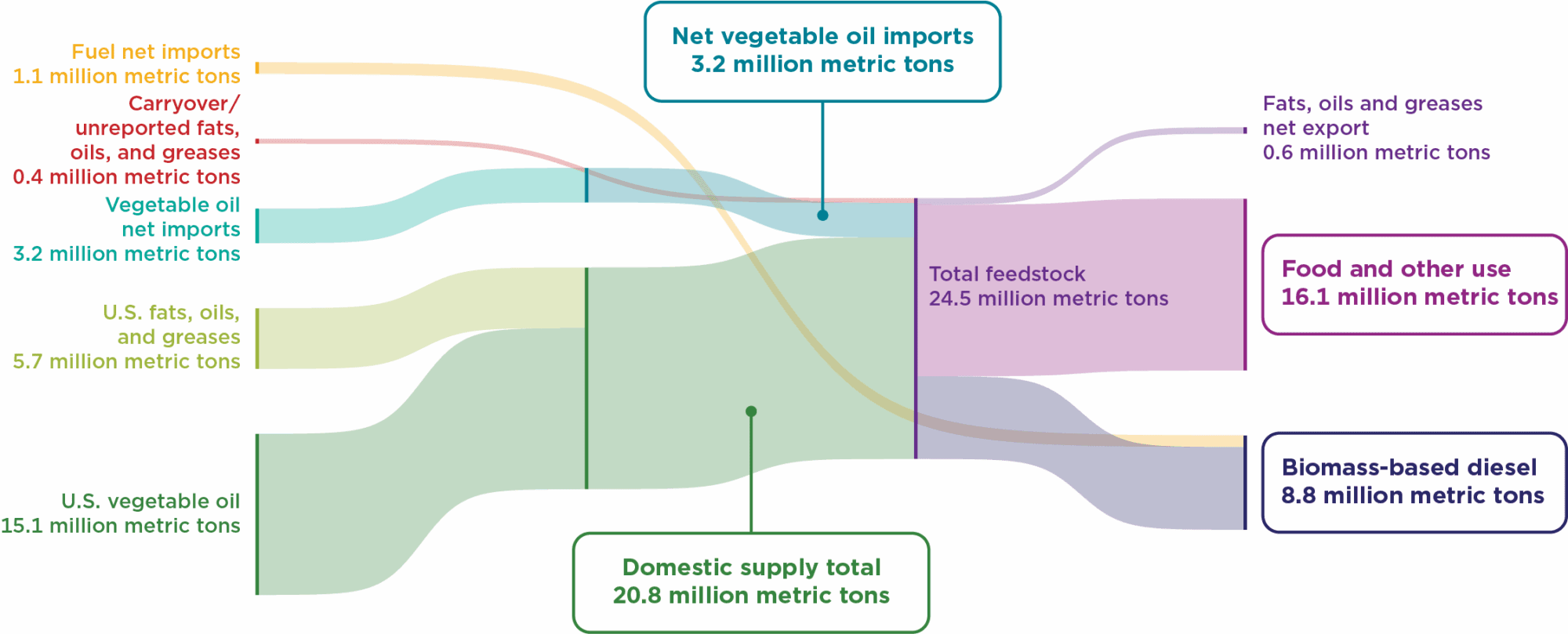
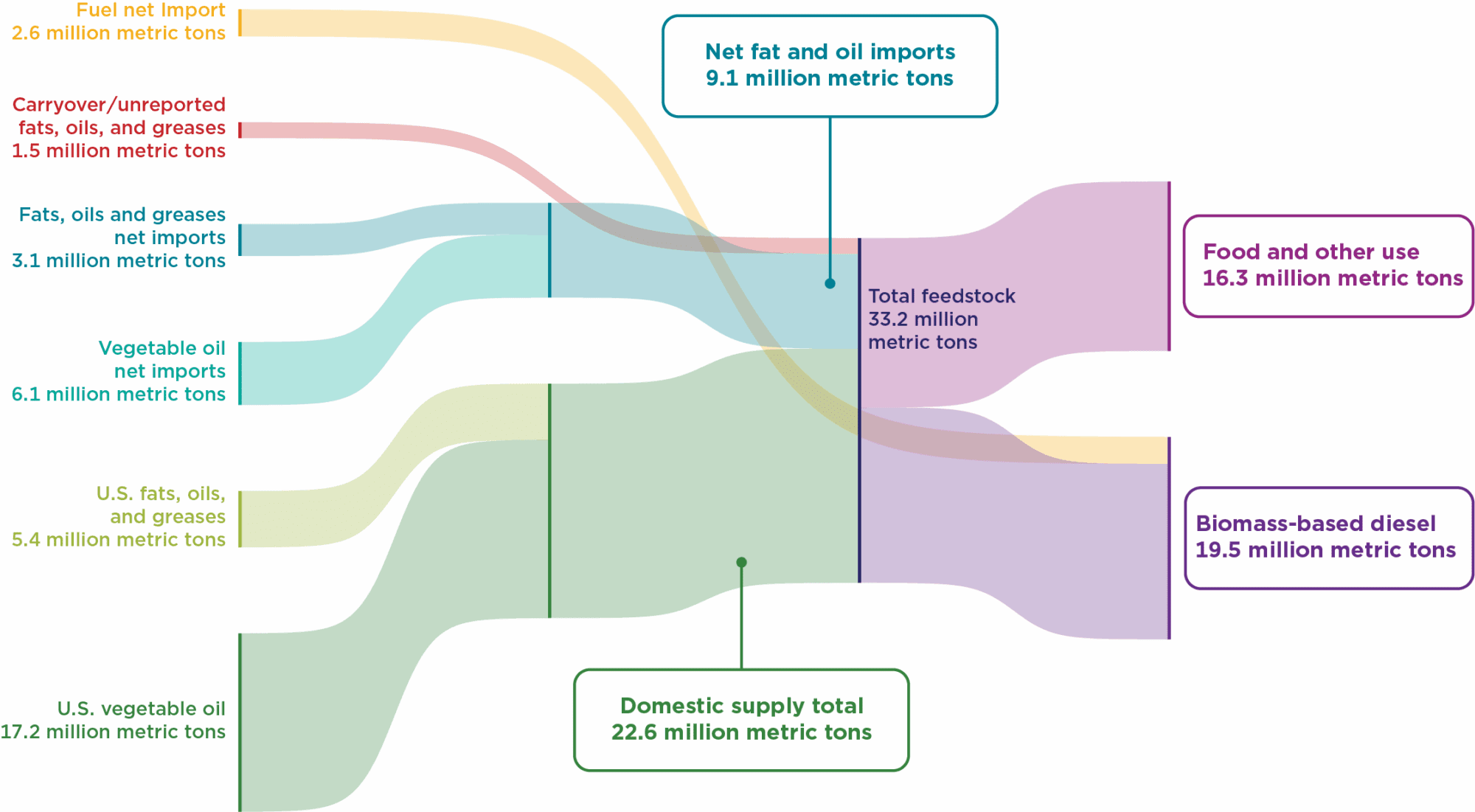
EPA’s proposal would only accelerate this trend, increasing reliance on imported fats, oils, and greases rather than wind them down. The next figure compares EPA’s projection of the 2027 BBD volumes needed to meet the current proposal with expected domestic fat and oil production and non-fuel consumption. Our projections assume the full utilization of soybean crushing capacity projected by the industry, representing a best-case scenario for domestic vegetable oil supply.
Figure 2. U.S. fats and oil supply and use in 2027 under current proposal
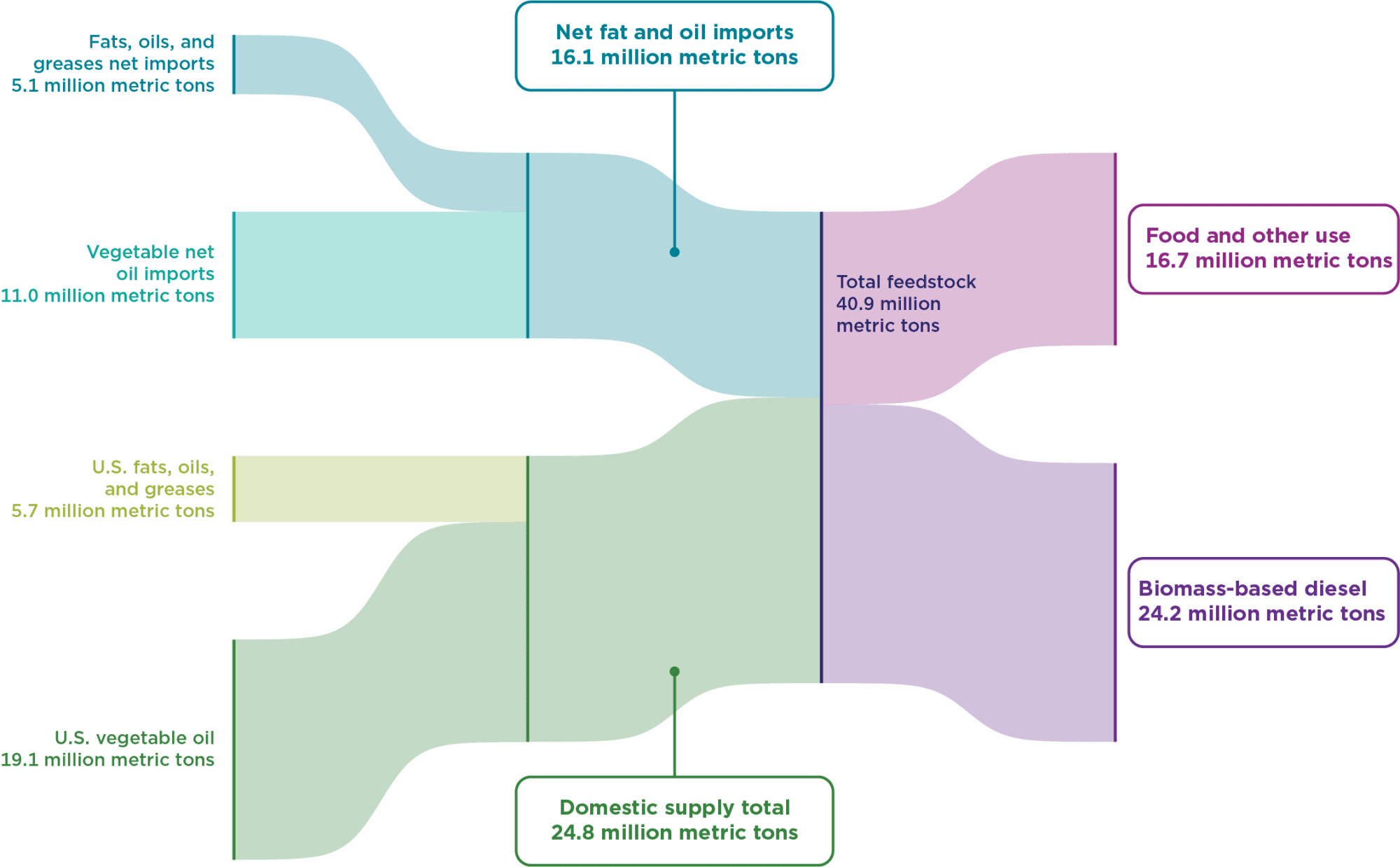
As illustrated by the figure, U.S. fat and oil imports would dramatically increase under the proposal; net vegetable oil imports are projected to surge by around 5 million tonnes (from 6.1 to 11.0 MMT). Greater demand for vegetable oil will increase its price, likely around 12% based on a previous analysis of the relationship between biodiesel demand and global vegetable oil prices.
However, a more dramatic price spike is possible. As described in EPA’s Draft Regulatory Impact Assessment, the 2020–2022 vegetable oil price shock that increased global prices from $700 to $1,800 per metric ton was likely caused by biofuel-driven demand and weather-related supply disruptions. The projected 5 million tonne net increase in U.S. vegetable oil imports is equivalent to 6% of the current global vegetable oil trade, creating a risk of short-term price spikes as global oilseed production responds to the additional demand.
According to EPA analysis, this huge increase in BBD consumption will not even meaningfully reduce U.S. GHG emissions, with savings equivalent to less than 1% of road sector emissions at best. One EPA model even suggests that the use of crop-based BBD fuels would increase GHGs. This is perhaps unsurprising, as current growth in vegetable oil production is concentrated in Brazil and Indonesia, where agricultural expansion often relies on high carbon-stock forested land. Indeed, groundbreaking work from Chen et al. has found that that global demand for BBD between 2002 and 2018 drove the conversion of approximately 1.7 million hectares of forest to oil palm. This means continued market-mediated oil crop expansion could very well offset any emissions reductions from additional BBD use in the United States.
Finally, the proposal’s claims of energy security benefits are unconvincing. Will energy security really be improved by replacing a domestic energy source (petroleum) with one we have to import? And while EPA assumes that the United States will remain the preferred destination for BBD feedstocks globally, this isn’t guaranteed. Changing policies in China have dramatically reduced used cooking oil exports to the United States, and sustainable aviation fuel mandates in the European Union and United Kingdom will heighten competition for feedstock.
Overall, EPA projects its current proposal will saddle consumers with $6.8 billion in extra fuel costs and $2.4 billion in higher food prices each year, all without meaningful emissions cuts or improved U.S. energy independence. Twenty years in, we need a wholesale reconsideration of the Renewable Fuel Standard— the inconsistencies of EPA’s proposal show exactly why reform is needed.
Author

Andy Navarrete
Researcher