
Blog
Smart policy for smart charging: The Electrification Action Plan is an opportunity to increase flexibility and boost smart charging at homes, workplaces, and depots
Here’s something that might surprise you: about 80% of electric vehicle (EV) charging happens at home, at work, or at depot facilities—not at the public charging stations that dominate policy discussions. That matters because EV owners in Germany without home chargers pay on average 42% more to recharge than those with private charging access.
Affordability isn’t the only advantage of private charging, which is also well suited for better grid management: EVs charging at private locations are often parked for multiple hours, meaning that they can charge when there is spare grid capacity (like overnight, when demand is low) and stop during peak hours. This is an example of how smart charging—whereby EVs charge at optimal times based on grid conditions, electricity prices, or renewable energy availability—helps make the most of existing capacity, delaying or avoiding costly grid upgrades while making the transition to decarbonized transport more flexible and affordable.
As EV adoption ramps up, more and more private chargers will be needed to meet demand. An ICCT study estimated that 150,000–176,000 private chargers would be needed for electric trucks in the EU in 2030. That number is closer to 20 million for light duty vehicles. To make charging affordable for users and alleviate load on the grid, large-scale deployment and utilization of smart private charging is critical.
The European Commission is currently developing the Electrification Action Plan (EAP), a roadmap to advance electrification in energy use across the EU. Ensuring that the EAP supports private smart charging access would be a boon to EV owners and grid operators alike. To do this effectively, the EAP could address four key considerations.
First and foremost, grid flexibility depends on widespread EV uptake. Providing certainty for investment decisions across the whole EV ecosystem is key to the quick increase in EV adoption needed to ensure cost-effective road transport decarbonization. For this, it is essential that the EU maintains ambitious CO2 standards. Meanwhile, the EAP could help reach these targets by including provisions to boost EV uptake.
Second, private chargers can be expensive to install, such as in old apartment buildings that may require retrofitting and other upgrades. While the 2024 Energy Performance Building Directive (EPBD) took an important first step by requiring the installation of private charging in new apartment buildings, among other locations, the EAP could go further in addressing cost barriers, such as by encouraging EU Member States to put in place cost-neutral financing programs and public-private partnerships to support charger deployment. For example, such programs could help spread the upfront costs of charger installation in apartment buildings among existing and future EV drivers as well as property owners. This model is already in place in programs in France and California. The EAP could also include a provision encouraging Member States to promote the deployment of private charging infrastructure in existing residential buildings and depots.
Third, without price signals or notifications indicating when electricity is cheapest and/or cleanest, EV drivers may not be aware of the best times to recharge. This, in turn, relies on the deployment of smart meters—which can adapt electricity flow in real time based on grid signals—and local time-based electricity tariffs, whereby electricity rates change throughout the day based on grid capacity and renewables availability.
The EU has already made some progress here: the smart meter deployment rate reached 63% in 2024, and there were approximately 390 cost-reflective tariffs for EV charging available as of early 2025, an improvement over previous years. But there is still more to be done. The EAP could incorporate a suggestion that Member States set targets for the full rollout of smart meters in houses, workplaces, and depots, and increase the availability of local cost-reflective electricity tariffs. The EAP is well placed for this comprehensive approach, as it covers not only electrification in the transport sector but also for buildings.
Figure. Number of smart energy tariffs and services (left, early 2025) and smart meter penetration (right, 2024) in Europe
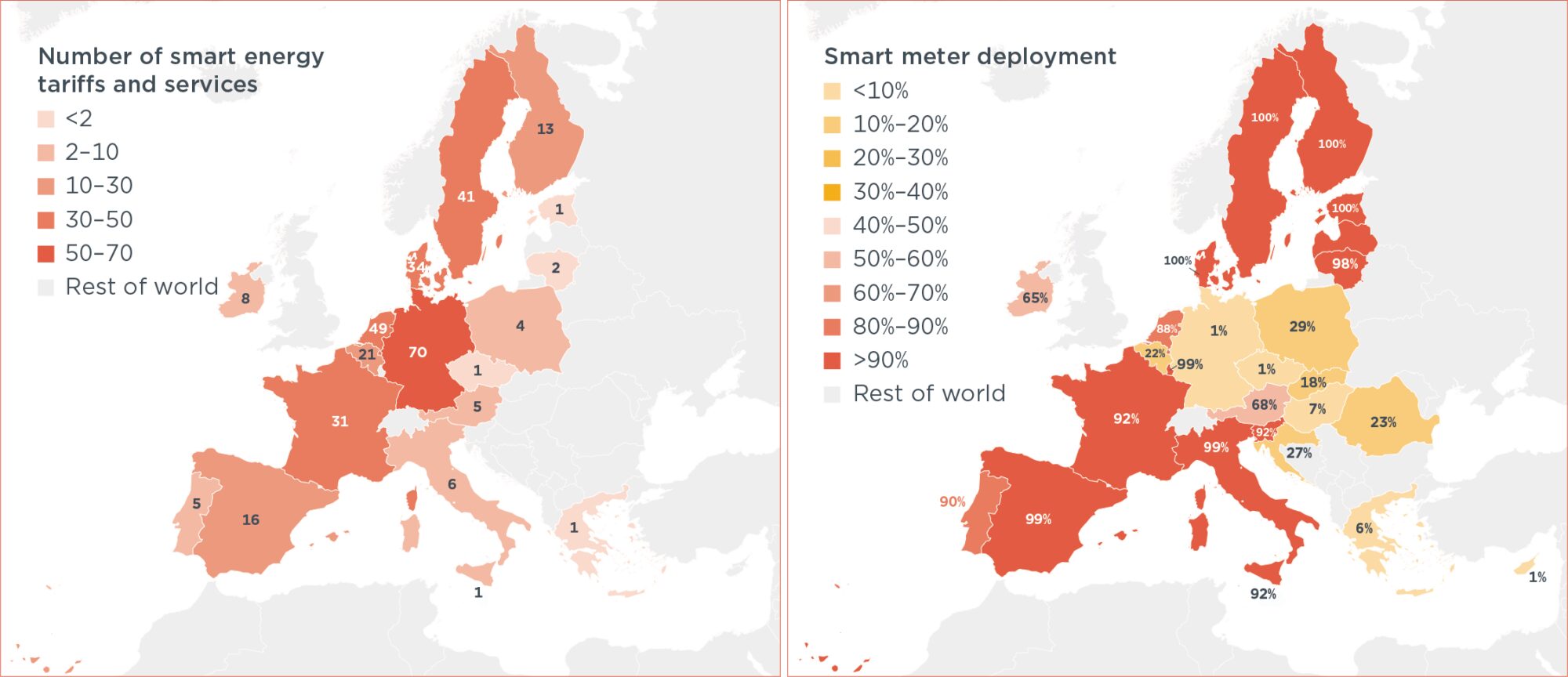
Data source: Imagine all the People (Regulatory Assistance Project, 2025), DSOs United in Diversity, Enablers of the Energy Transition (DSO Entity, 2024).
Fourth, while there is already legislation in place requiring that all chargers be smart-charging capable, there are currently no measures to ensure that this smart charging capability is being used; this could lead to missed flexibility opportunities and foregone savings for grid operators and drivers.
The UK’s 2021 Electric Vehicles (Smart Charge Points) Regulations provide a valuable model for making smart charging the default for private charging—and, by extension, raising consumer awareness about smart charging. Under these regulations, instead of EV drivers having to actively choose to employ smart charging options, smart charging is the default setting for private charging. Furthermore, these regulations effectively balance these energy system needs with consumer flexibility at places like home and work. Components of the UK legislation that could be adapted for the EAP include:
- Default off-peak charging schedules: Charge point sellers must set up default charging schedules that encourage off-peak charging—that is, charging outside of those peak hours when people are waking up or coming home after work and turning on lights, washing machines, heaters, and other appliances. Setting default charger schedules increases users’ awareness of electricity pricing and minimizes grid strain, optimizing existing grid capacity. To maintain flexibility, users may still override this schedule to suit their personal needs.
- Randomized delay function: To avoid grid instability and prevent surges in grid demand (e.g., at the start of off-peak times), a randomized delay of up to 10 minutes is applied when charging begins; this delay can be extended up to 30 minutes if needed to protect the grid, unless the user overrides it for that session.
- Electricity supplier interoperability: To foster competition and user choice, charge point sellers must allow switching between electricity suppliers—just as a customer can switch carriers without having to buy a new phone. Interoperability is also vital to ensure that any EV can use any charger’s smart features regardless of vehicle make or electricity supplier, avoiding technical lock-ins.
- Enforceable penalties: Charge point sellers face penalties if they fail to comply with these requirements, ensuring accountability.
The EAP could go a step further by linking smart charging with real-time electricity costs. If an EV driver’s electricity plan already adjusts prices throughout the day, their charger could automatically wait for the cheapest times to charge—not just operate according to the default off-peak schedule. This would not only reduce strain on the grid, it would also make charging more cost-effective for EV drivers.
In the UK, updating chargers to meet these requirements did come with slight increases in prices. But, in a short time, economies of scale have more than compensated for this increase. An evaluation of this regulation commissioned by the UK government a year and a half after its implementation showed that between 2020 and 2023, the average price of private chargers decreased by more than 30%. Forthcoming data on EV drivers’ responses to the legislation—based on a survey the UK government is slated to conduct by the end of 2025—will shed further light on the impact of the legislation on EV drivers’ behavior.
The EAP is well placed to ensure EV drivers can recharge conveniently and at lower rates in private places while assisting grid operators in managing EV grid demand. Smart policy is key to making smart charging accessible and affordable for all.
Author

Marie Rajon Bernard
Senior Researcher
Related Reading
Charging infrastructure needs for battery electric trucks in the European Union by 2030
This study quantifies BET charging needs in the EU-27 by 2030 and compares them to the AFIR targets by modeling the expected stock of BETs and considering their energy consumption, driving patterns, and charging behavior.