
Blog
VECTO versus real-world testing: How does fuel economy compare in Europe’s trucks?
The fuel economy of trucks in Europe was historically hard to verify; there was no standardized method to tell you how much bang you could get for your truck. That changed in 2017 with the introduction of VECTO, a simulation tool which requires truck makers to certify the fuel economy and CO2 emissions of most of their trucks by using a uniform and clearly defined approach.
By 2021, heavy-duty vehicle certification data from the European Union (EU) were a publicly available source of information to assess manufacturer progress with the CO2 standards. Data on the performance of nearly every truck first registered in the EU between 2019 and mid-2024 can now be freely downloaded from the European Environment Agency (EEA).
In addition to information on fuel economy and CO2 emissions, these data offer insights into the approaches manufacturers are using to meet their emissions reduction targets. For example, the data show that MAN and DAF have focused almost exclusively on improving the efficiency of their diesel vehicles, while Volvo Trucks and Renault Trucks have focused more than their competitors on producing zero-emission vehicles.
Data from Scania are also noteworthy. According to their 2019 VECTO certifications, Scania 4×2 long-haul tractor-trailers—the most popular truck in the EU—had an air drag of approximately 4.6 m2. By comparison, all other manufacturers were nearer to 5.8 m2. The lower the air drag, the less resistance a truck faces and the more efficient it is; sure enough, in 2019, the VECTO-rated fuel consumption of Scania’s tractor-trailers was about 9% lower than that of competitor models. Some manufacturers have since narrowed this gap. Most notably, DAF’s air drag improved from 5.9 m2 in 2021—the second highest of all manufacturers at the time—to 5.0 m2 in 2022, second only to Scania.
Figure 1. Air drag performance for 4×2 tractor-trailers
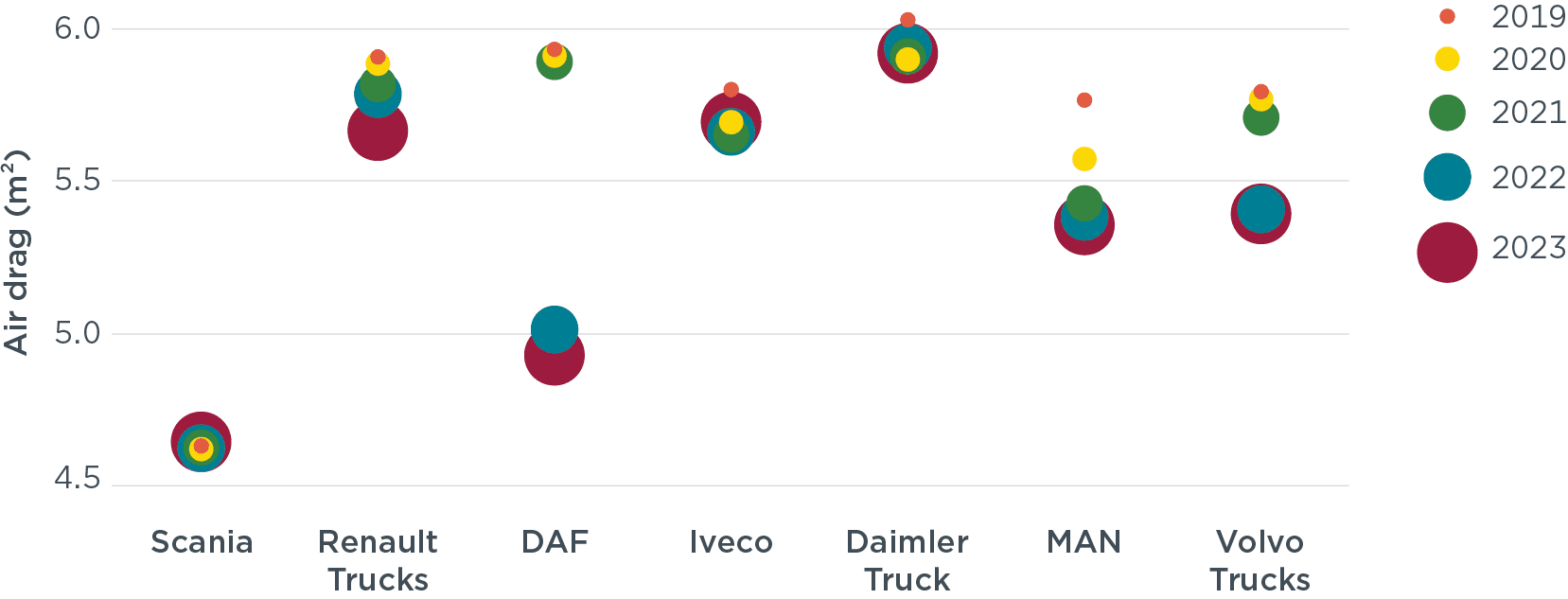
Data source: EEA
Since fuel accounts for one-third of a transport operator’s costs, trucks with better fuel efficiency can save operators some serious money. But do the reported VECTO fuel efficiency data hold up in real-world driving?
To help answer that question, the ICCT reviewed the archive of Lastauto Omnibus, Europe’s oldest commercial vehicle magazine, which until 2022 published monthly reports on the fuel consumption of the EU’s most popular truck models, run on the same track at a set speed profile and payload. Since 2020, the magazine has also reported VECTO-certified CO2 emissions. This allowed us to identify the VECTO-certified fuel consumption from the EEA’s database for each truck tested by Lastauto Omnibus. We then compared the VECTO-certified fuel consumption (specifically, the long-haul reference mission profile) to Lastauto Omnibus’s on-road values.
No one should expect these values to match perfectly. The speed traveled and loads carried as simulated in VECTO vary from those used by Lastauto Omnibus. Nevertheless, the use of two consistent testing procedures should theoretically show consistent differences in fuel consumption across vehicles. But they don’t.
Of the 13 trucks for which we compared Lastauto Omnibus reporting and EEA data, the magazine reported an average on-road fuel consumption around 11% higher than the official VECTO values for manufacturers. There were outliers, though.
The smallest difference was seen in trucks from Daimler, Europe’s largest truck maker, whose average fuel consumption according to Lastauto Omnibus was 8% higher than their VECTO values; Daimler’s Actros Gigaspace (the largest Actros cab variety) showed just a 5% difference. On the other side was Scania, whose fuel consumption across five trucks analysed was 14% higher, on average, than VECTO-certified levels.
Figure 2. Difference in fuel consumption between Lastauto Omnibus reporting and VECTO certification
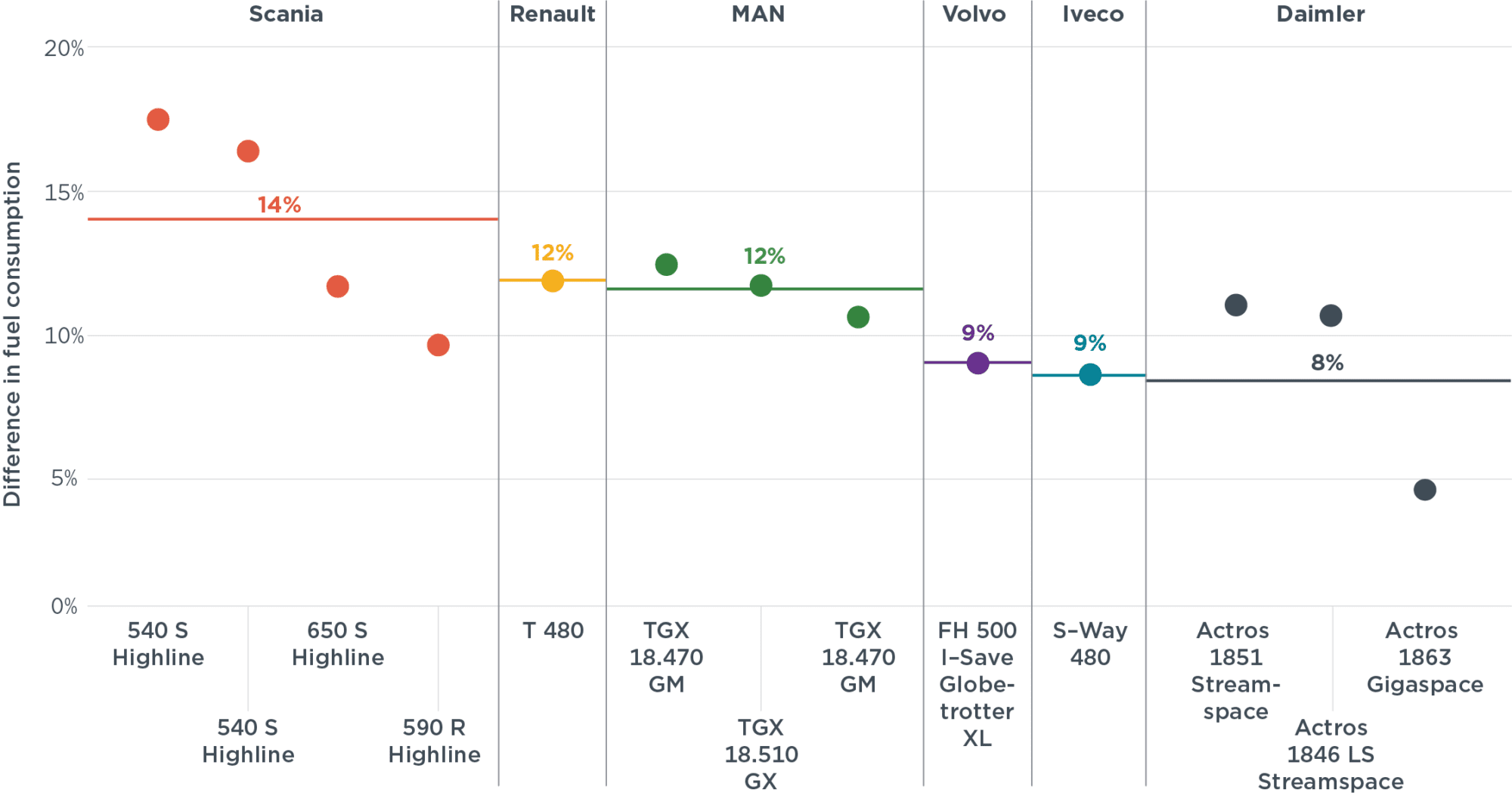
Data sources: Lastauto Omnibus, EEA
Manufacturers can benefit from having lower VECTO-certified emissions. For example, between 2019 and 2023, Scania received credits for producing vehicles with lower VECTO-certified emissions than their competitors. If Scania were to miss their 15% CO2 emissions reduction target for 2025, they could use these credits to avoid paying any fines. The avoided penalties in this hypothetical scenario could be worth approximately €1.9 billion for Scania based on the accumulated credits over the 2019–2023 period.
Moreover, manufacturers that report lower CO2 emissions than their competitors could also potentially attract customers with the prospect of lower toll costs due to the European Commission’s introduction of CO2-based tolling costs in 2022. While the relationship between reported VECTO values and market share has not been empirically established, Daimler Truck recently claimed before a regional court that improper fuel consumption and CO2 emissions certifications have unfairly resulted in market share losses as customers sought more efficient trucks.
Multiple factors can influence the decision to purchase a truck, including total cost of ownership, brand loyalty, and reported fuel efficiency. Data for 2019–2024 show fluctuations in market share among manufacturers, with Scania’s share of 4×2 tractor-trailers declining initially before recovering after 2022.
Figure 3. Market share of 4×2 tractor trailers in the EU-27

We found no obvious technical explanation for the differences between manufacturer-reported VECTO data and Lastauto Omnibus measurements. Moreover, the ICCT cannot vouch for the accuracy of data compiled or reported by third parties. While several factors could explain some variation, the consistency of differences within certain manufacturers’ fleets, including Scania, warrants closer examination.
Regulators are already working to identify and close potential loopholes in the system for certifying fuel economy and CO2 emissions. For example, in 2025, the European Commission introduced in-service verification, which takes a selection of trucks from the road and tests several of their components—including air drag. Significant differences between a manufacturer’s VECTO-reported values and those found from this in-service conformity verification will result in manufacturer’s emissions being retroactively updated starting from 2025.
We will be watching closely over the coming years to see if manufacturer-reported aerodynamic performance starts to decline compared to what we see today.
Authors

Eamonn Mulholland
Senior Researcher
Alex Plummer
Student Assistant
Related Reading
This study analyses the baseline data to understand how the industry currently performs compared to the targets set out by the European Commission. The analysis is intended to inform the discussions on the review of the standards that will take place in 2022.