A lump of coal in the Christmas stocking: Renewable fuels in the car CO2 standards
Policy Brief
Unwrapping the European Commission’s Christmas gift: Risks and opportunities of the proposed CO₂ standards
In December 2025, the European Commission presented a draft amendment to the European Union carbon dioxide (CO2) standards for cars and vans as part of the Automotive Package, a larger regulatory package focused on supporting Europe’s automotive industry.
This policy brief reviews the proposed amendment, including revisions to the CO2 targets, credits for low-carbon fuels and steel, and super credits for small and affordable battery electric vehicles. It also assesses the impact of these changes on the future electric vehicle uptake and tailpipe CO2 emissions.
Turning away from the 2035 100% CO2 reduction target
The current standards require vehicle manufacturers to reduce their CO2 emissions of new cars and vans by 55% by 2030 (50% for vans) and 100% by 2035, respective to a 2021 baseline. The proposal outlines a shift away from 100% zero-emission vehicles by 2035 for both cars and vans, replacing it with a 90% reduction target and introducing an averaging of CO2 emissions over the period 2030 to 2032. In addition, for vans, a relaxed target was proposed for 2030, requiring a CO2 reduction of only 40%.
New cars and vans registered from 2035 onwards can have average CO2 emissions of 11 g/km and 18 g/km, respectively, provided these emissions are offset by credits for the use of low-carbon steel and renewable fuels. The proposal does not set a new target date for a 100% CO2 reduction.
Impact on EV uptake and CO2 emissions if compensation measures are too weak
ICCT’s modeling indicates that by 2030, the share of battery electric vehicles could fall by 17 percentage points, from 61 to 44%. By 2035, the fleet composition could stabilize after 2035 with a share of electric vehicles that, depending on the distribution of plugin hybrid vehicles and internal combustion engine vehicles in the fleet, could range between 80% and 90%. This would translate to between 1.3 and 2.6 million fewer electric vehicles sold each year in which the target is kept at 90% relative to the current regulation.
Figure. Impact of the revision on the market share of battery electric vehicles

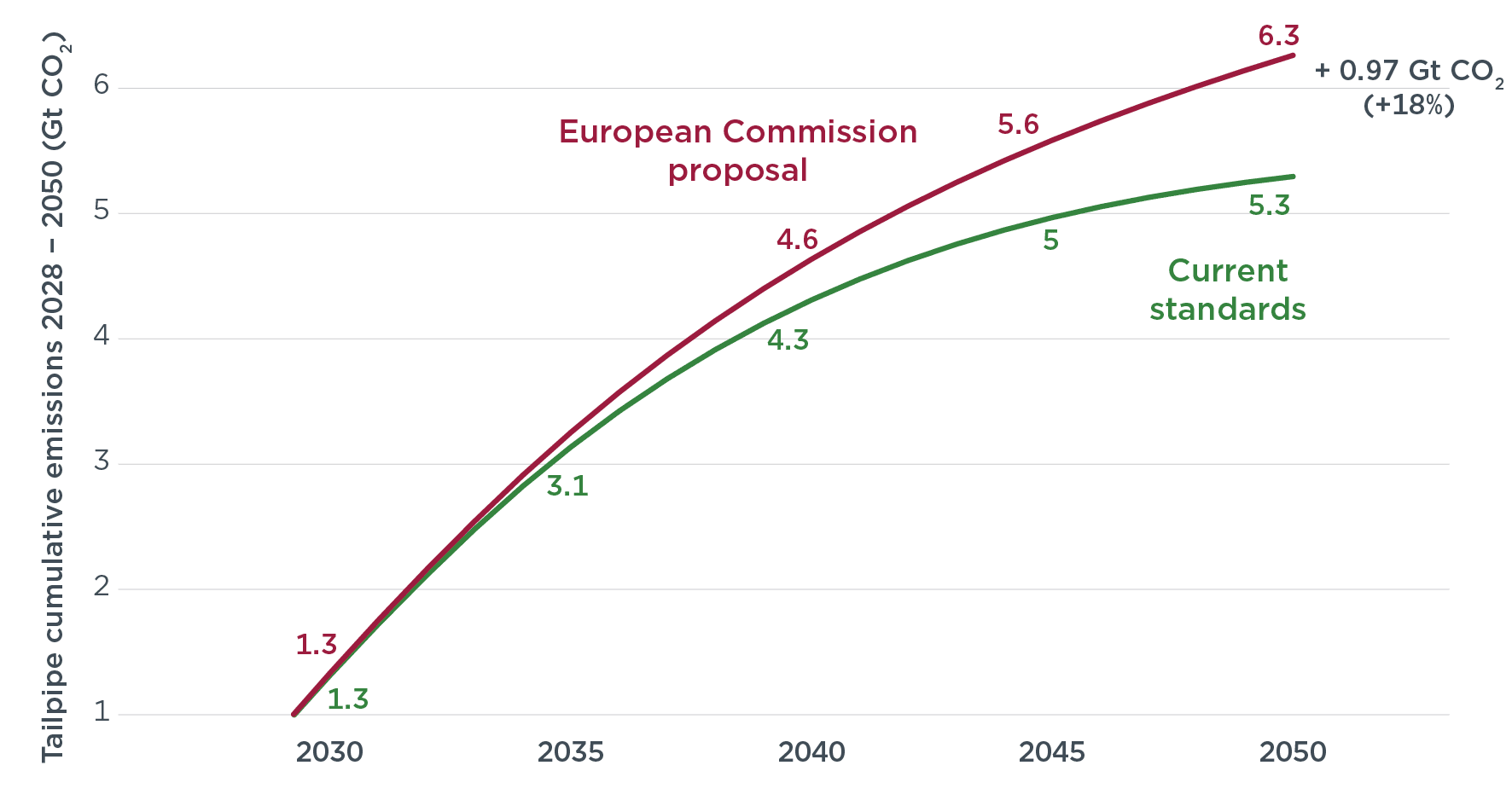
The strongly reduced uptake of battery electric vehicles and the lack of a phase-out target would result in substantially increased total tailpipe CO2 emissions. Compared to the total projected car CO2 emissions of 5.3 gigatons over 2028–2050 under the current regulation, emissions would rise by about 1 gigaton to 6.3 gigatons—an increase of more than 18%. This is equivalent to 1.4 times the annual greenhouse gas emissions of Germany.
It is therefore essential that the proposed mechanisms to offset the additional CO2 emissions and to accelerate the uptake of small affordable electric vehicles are robust and unambiguous. By addressing the gaps and questions in the current proposal, the EU can keep its climate ambitions on track while supporting affordable electric mobility—but stumble on the details and the proposal could pave the way for excess emissions and forfeited leadership in the global race to zero.
Figure. Impact of the revision on the cumulative tailpipe emissions between 2028 and 2050